
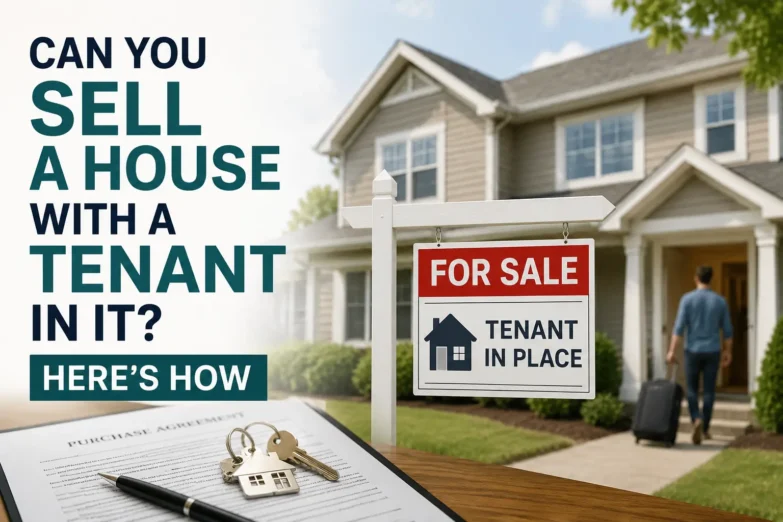
Selling a property with a tenant living in it is one of the more common situations landlords face, and it’s also one of the most legally tangled. From what we’ve seen across hundreds of Wisconsin landlords over the years, most people overestimate how restrictive the rules are and underestimate how the type of lease changes everything. This guide walks through what Wisconsin law actually allows, your real selling options, and the timing involved. No matter where you are in the process, you have more flexibility than you probably think.
The Short Answer: Yes, You Can Sell
You can sell a property with a tenant in it. The question isn’t whether you can sell, it’s how the existing lease affects the sale. Under Wisconsin Statute § 704.09, a buyer takes title subject to the tenant’s rights. That means the sale itself doesn’t terminate the lease. The new owner steps into the seller’s shoes as landlord, and the lease continues unchanged until it expires.
The practical implications depend almost entirely on what type of tenancy is in place.
Lease Types and What They Allow
The type of agreement you have with your tenant determines how quickly you can move toward a vacant sale. Here’s the breakdown under Wisconsin Chapter 704:
| Lease Type | What It Means for Selling |
| Fixed-term lease (e.g., 12-month) | Lease continues until expiration. Buyer takes property subject to the lease. Cannot terminate unilaterally without tenant breach. |
| Month-to-month tenancy | Can be terminated with 28-day written notice before the end of any rent-paying period. |
| Week-to-week tenancy | Can be terminated with 7-day written notice. |
| Year-to-year tenancy | Can be terminated with at least 28 days’ written notice before the end of the lease year. |
| Tenant at will (no agreement) | Treated as month-to-month for notice purposes. |
This matters because most real-estate buyers (owner-occupants) want a vacant home. If your tenant is locked into a 9-month fixed-term lease, you’re either selling to an investor who’s fine inheriting the tenant, or you wait until the lease expires.
How Soon Can You Move to Selling?
The short answer: immediately. You can list the property tomorrow with a tenant in place. The complication isn’t listing, it’s matching the right buyer to your tenant situation.
If you have a fixed-term lease in place: You can sell now, but your buyer pool narrows to investors who are happy to inherit the lease. Most of them will be, since occupied rentals come with built-in cash flow.
If you have a month-to-month tenancy: You can serve a 28-day notice today and target a vacant sale roughly 30 to 45 days out, giving you time to list and close with a vacant unit.
If you want to sell to an owner-occupant and the lease has more than 60 days left: You’re typically waiting for the lease to expire. The alternative is negotiating an early move-out with the tenant, which we’ll cover below.
Pro tip: Don’t assume your buyer cares about the tenant situation. A surprising number of buyers are landlords or aspiring landlords, and an occupied property with a paying tenant and a security deposit already on hand is actually attractive to that audience. Listing the property as “tenant occupied, lease through [date]” filters buyers correctly from day one and saves everyone time.
When a Lease Can Be Terminated Early
Wisconsin law gives landlords specific tools to terminate a lease before its scheduled end date, but only when the tenant breaches it. These are governed by Wis. Stat. § 704.17:
5-Day Cure Notice. For breaches that can be remedied (late rent, lease violations). Tenant has 5 days to fix the issue. If they don’t, you can begin eviction.
14-Day Notice (no cure option). For tenants who have already received a 5-day notice in the past 12 months, or for serious breaches. The lease ends in 14 days regardless of any remedy.
Imminent Harm Notice. For tenants posing an imminent threat to other tenants. Specific procedural rules apply under Wis. Stat. § 704.16.
Criminal Activity. Specific drug-related or violent crime situations can also support immediate lease termination under state law.
Selling the property is not a legal basis for terminating a tenant’s fixed-term lease. Wanting to sell faster doesn’t create a right to evict. If you try, you’re looking at a breach-of-lease lawsuit from the tenant, possible damages, and a much worse outcome than just waiting out the lease.
Negotiating an Early Move-Out (Cash for Keys)
When you have a fixed-term lease but want to sell to an owner-occupant, the cleanest legal path is negotiating a voluntary early termination with the tenant, sometimes called “cash for keys.”
How it works:
- You offer the tenant a cash incentive to vacate before the lease expires
- Both parties sign a written termination agreement
- The tenant moves out by the agreed date
- You return the security deposit (plus the incentive payment)
- You sell with a vacant unit
Typical incentive amounts range from one to three months’ rent, depending on how much time remains on the lease and how motivated you are to sell vacant.
Pro tip: Always get the termination agreement in writing, signed and dated by both parties. The agreement should specify the move-out date, the cash amount, that the tenant releases any claims against the landlord related to the early termination, and confirmation that the security deposit will be returned per the lease terms. Verbal agreements fall apart, and Wisconsin courts won’t enforce them as reliably as written ones.
Your Real Options for Selling
Option 1: Wait for the Lease to Expire
If the lease ends within 60 to 120 days, waiting is often the simplest path. You give the appropriate notice for a periodic tenancy, or simply let the fixed-term lease expire, and then list with a vacant unit. Best for landlords who aren’t on a tight timeline.
Option 2: Sell to the Tenant
If the tenant has been there a while and is paying reliably, ask if they want to buy. They already know the property, may have an emotional attachment, and avoiding a vacancy benefits both parties. Best when the tenant has financing capability and stable employment.
Option 3: Sell With the Lease in Place to an Investor
The buyer takes title subject to the existing lease under § 704.09. Investors, particularly buy-and-hold landlords, often prefer occupied properties because they generate income from day one. This is the path of least resistance for fixed-term leases.
Option 4: Negotiate Cash for Keys, Then List to Owner-Occupants
Pay the tenant to leave early, then list with a vacant unit to the widest possible buyer pool. Costs a few thousand dollars in incentive money, but often nets a higher sale price by widening the buyer market.
Option 5: Sell Directly to a Cash Buyer
The fastest, cleanest path when the property has issues that complicate a traditional listing (deferred maintenance, problem tenants, properties spread across multiple cities). Cash buyers purchase as-is, work with existing tenants in place, and close in 1 to 3 weeks. This option also works well when you want to exit the rental business entirely without managing showings, repairs, or tenant logistics.
If you’re focused on speed specifically, our guide on how to sell your house fast covers the timeline mechanics and the real net comparison.
Why a Cash Sale Works Well for Rental Properties
For landlords specifically, a cash sale removes the variables that make selling occupied properties complicated:
No coordinating showings around a tenant’s schedule. Under ATCP 134 and Wis. Stat. § 704.05, landlords must provide at least 12 hours’ written notice before entering a tenant-occupied property for showings. Cash buyers typically do one walkthrough, not weeks of showings. That’s far easier on you and your tenant.
Tenant relationships stay intact. We buy properties with tenants in place regularly. The tenant keeps their lease, keeps their home, and the only thing that changes is who they send rent to. From what we’ve seen, this is often a relief to tenants who’d otherwise worry about being displaced.
No financing contingency risk. Most traditional buyers of rental properties are using investment property financing, which has stricter underwriting and more frequent fall-throughs than owner-occupied loans. Cash eliminates that risk entirely.
Closings work around your schedule. When you’re managing multiple properties or tenants, the flexibility to close in 7 days or 30 days based on what’s convenient for you (and your tenant) matters more than people realize.
No commission, no closing costs on your end. Standard 6% commission on a $250,000 rental property is $15,000. Add closing costs and you’re looking at a $20,000+ deduction from a traditional sale. Cash sales typically skip both.
Showing the Property: What’s Legally Allowed
If you list traditionally, you’ll need to show the property to buyers. Wisconsin law has specific rules:
- You must give at least 12 hours’ written notice before entering for showings (Wisconsin requires written notice, not verbal)
- Entry must be at reasonable times
- The tenant has the right to refuse entry only in narrow circumstances (sickness, disability, emergency conflict)
- You cannot use showings to harass a tenant or pressure them to leave
The Wisconsin State Bar’s public guide on landlord-tenant law recommends communicating directly with the tenant before listing, sharing the marketing plan, and offering some level of flexibility (such as setting weekly showing windows) to reduce friction. Tenants who feel respected through the process are far more cooperative than tenants who feel blindsided.
Documentation You’ll Need
Whether you sell with tenants in place or after they move out, gather these documents before listing:
- Signed lease or rental agreement
- Rent roll (current rent amount and payment history)
- Security deposit accounting
- Tenant application and contact information
- Check-in inspection report (required under Wis. Stat. § 704.08 since 2011)
- All written notices given to the tenant
- Domestic abuse protection notice (required for leases since March 2014)
- Lead-based paint disclosure (for pre-1978 properties)
- Records of repairs and maintenance
The buyer’s attorney or title company will ask for these documents during due diligence. Missing or incomplete records can stall closing.
Security Deposit Transfer at Closing
Security deposits don’t belong to the seller, they belong to the tenant. At closing, the deposit must transfer from you to the buyer, who becomes responsible for returning it under the lease terms when the tenancy ends. This is typically handled as a credit to the buyer on the closing statement.
Pro tip: Reconcile the security deposit before closing. If you’ve been deducting cleaning fees, repair costs, or late charges from it over the lease term, document everything in writing. The buyer needs an accurate accounting, and unresolved deposit disputes are a common source of post-sale conflict with tenants.
Final Thoughts
Selling a property with tenants is not the legal minefield most landlords assume. Wisconsin law is clear: existing leases transfer to the buyer, fixed-term leases continue until expiration, and periodic tenancies can be terminated with the appropriate notice. The actual complication is matching the right type of buyer to your tenant situation.
If you want a vacant sale to maximize the buyer pool, negotiate cash for keys or wait out the lease. If you want speed and simplicity without disrupting the tenant, an investor or cash buyer is usually the better fit.
If you’re a Wisconsin landlord ready to exit a rental property, whether occupied or vacant, Fair Deal Home Buyers buys tenant-occupied properties regularly and respects existing leases as part of the purchase. Our 3-step process gets you a written cash offer in 24 hours, with a closing date you control. No commission, no repairs, no showings to coordinate around your tenant.
Visit our website or call 414-409-8251 to discuss your rental property situation.
Frequently Asked Questions
Can you sell a house with a tenant in it?
Yes. Wisconsin law allows the sale of tenant-occupied property, but the existing lease transfers to the buyer under Wis. Stat. § 704.09. The lease continues unchanged until it expires.
How much notice do I have to give a tenant if I’m selling?
None for the sale itself, since the sale doesn’t terminate the lease. If you want a vacant sale, you need to terminate a periodic tenancy with the required notice: 28 days for month-to-month, 7 days for week-to-week, and at least 28 days before the end of a year-to-year lease.
Can I evict a tenant because I want to sell?
No. Wanting to sell is not a legal basis for eviction in Wisconsin. You can terminate at lease end, you can negotiate an early move-out, or you can sell with the lease in place. You cannot force a fixed-term tenant out simply because you want to sell.
What happens to my tenant’s security deposit when I sell?
The deposit transfers to the buyer at closing as a credit on the closing statement. The buyer becomes responsible for returning it to the tenant under the lease terms.
Can I show the property while the tenant is still living there?
Yes, with at least 12 hours’ written notice before each showing. Entry must be at reasonable times, and tenants generally cannot refuse access for legitimate showings.
Can cash buyers buy a property with tenants in place?
Yes. Many cash buyers, including us, specifically purchase tenant-occupied properties and continue the existing lease without disruption. The tenant keeps their home, the lease stays in place, and only the ownership changes.
Do I need to disclose the lease to potential buyers?
Yes. Wisconsin’s Real Estate Condition Report and disclosure requirements obligate you to share the existence of an active lease, the term remaining, the rent amount, and the security deposit held. Failure to disclose can lead to lawsuits from the buyer post-sale.


